
Official website
Our website
The main public website for DSTI School of Engineering: institutional information, programmes, campuses, admissions and resources, including the DSTI TechBlog for technical articles and project stories.
Start with the full decision: France is the destination. AI, Data and Cyber are the opportunity. DSTI is the specialised, flexible, English-taught engineering pathway.
Version: 14 October 2026.
Start by positioning France as a high-value European choice, not as a fallback destination. This helps families understand why studying in France can be academically, professionally and personally attractive.
France combines long-standing academic strength with an increasingly international higher-education offer.
Internships, global companies and access to the European job market make France a serious career platform.
France offers quality education, healthcare and social support in a cost structure often more balanced than other major destinations.
Students and families also buy a life experience: safety, culture, gastronomy, mobility and European travel.
France offers a rare combination: mathematical tradition, engineering culture, industrial power and national strategic sectors that need AI, data and cyber security talent.
France has a centuries-old and deep tradition in mathematics, scientific research and engineering education — especially relevant for AI and computing.
Only independent country in Europe for civil and military nuclear, aerospace and defence. Also finance, telecoms, luxury, mobility and healthcare all require robust digital systems.
France's digital economy and international responsibilities connect international organisations, research institutions, large corporations, startups and specialised technology clusters.
Continental Europe, including France, is largely a Master's-level market for specialist, engineering, architecture and leadership-track roles. This is a key argument when advising students who want long-term career mobility in AI, data or cyber.
Sources: Institut National de la Statistique et des Études Économiques (INSEE: the French National Institute for Statistics and Economic Studies) data on digital professions in France, including employment levels, educational attainment and managerial responsibilities.
When families compare destinations, remind them that France is not only about getting a first job. It is also about entering a labour market with strong protections, paid holidays, healthcare access and structured routes from study to employment.
France combines serious careers with real quality of life: 5+ weeks of paid leave, public holidays, strong protections, and a highly productive work culture.
France combines a strong private-sector job market with social protections such as healthcare coverage and regulated employment conditions. For many families, this is part of the value of studying in Europe.
In France, the final-year internship is often a real pre-recruitment mechanism. It is not just “work experience”; it can be the bridge between student status and a first professional role.
Sources: Service-Public.fr confirms paid leave accrues at 2.5 working days per month and that internships have a maximum duration of 6 months. Service-Public.fr also notes that, when a trainee is hired within 3 months after the end of the internship, the internship duration is deducted from the trial period and taken into account for seniority-related entitlements.
DSTI prepares students and experienced learners for the job market through technical depth, professional certification preparation, internship or professional-application work, career coaching and active follow-up from academic and corporate relations teams.
At DSTI, employability starts before the internship or professional application phase. Academic progression, projects, certifications, public profiles, career preparation and corporate relations work together so learners can show what they can build, analyse, secure and explain.
In France, internships are regulated and paid when they exceed two months in duration. This gives international students a more structured and professional internship experience than in many countries where internships may remain unpaid or informal.
Actual salaries depend on the role, sector, location, language level, prior experience and market conditions. The figures below are indicative early-career gross annual salary ranges for France.
Learners build evidence of practical ability through demanding technical work.
Programmes prepare students for external certification exams recognised by employers.
CVs, cover letters, public profiles and job-search strategy are actively covered.
Learners benefit from job-board guidance, employer connections and corporate follow-up.
Outcomes are strongest when learners actively engage, apply, practise and follow through.
More than 600 companies have employed DSTI students and graduates across France, Europe and the wider world. The logos below are not random: each one corresponds to a public LinkedIn example used in DSTI applicant information material.
They make real pathways easier to read without presenting any employer as a guaranteed destination.


















DSTI also works with managers, engineers, consultants and entrepreneurs who study while carrying professional responsibilities. For them, employability is not only first employment: it can be career repositioning, leadership, AI transformation responsibility or stronger technical credibility.
The Direction of Studies and Corporate Relations teams help learners prepare their profile, understand the market, target opportunities, use the right platforms and follow through professionally. DSTI can guide and support, but outcomes remain linked to effort, maturity, language development, timing and the market.
DSTI prepares learners for employability from day one: rigorous technical education, hands-on projects, professional certification preparation, internship or professional-application work, CV and public profile support, corporate relations and active follow-up.
Reference points: DSTI Careers information; official French rules on internship remuneration. Employment and salary figures are indicative DSTI internal / institutional guidance and should not be presented as individual guarantees.
DSTI teaches in English, so students can start their academic journey without already being fluent in French. But students who use their time in France to learn French add a powerful long-term career asset.
French helps with housing, internships, administration, social life and integration. Even basic progress can make students feel more confident and independent.
English opens the classroom; French opens more of the local job market, client-facing roles, public-sector environments and long-term career opportunities.
French is spoken across Europe, Africa, North America and international organisations. Demographic growth in Francophone Africa means today's students may work in a world where French is even more influential.
Several projections have argued that French could become one of the world's most spoken languages by 2050, largely because of demographic growth in Africa. The exact ranking is debated, but the strategic direction is clear: French is not a language of the past.
Source: France 24 reported on projections suggesting French could become the world's most spoken language by 2050; this projection is best presented as a powerful trend signal, not as a guaranteed ranking.
Many students say “I want AI” without knowing whether they mean data science, data engineering, analytics, software or cyber. Use these simple explanations to guide them towards the right programme.
How do banks transfer money securely? How does Netflix serve millions of users? How do Amazon, Google and cloud systems remain available despite failures and attacks?
How do we predict behaviour, optimise decisions, model physical systems, process signals or recommend content?
| Role | Simple explanation for families | Typical DSTI pathway |
|---|---|---|
| Data Scientist | Builds and evaluates AI and statistical models. | MSc Data Science & AI |
| Data Engineer | Builds the data pipelines, platforms and infrastructure that make AI work at scale. | MSc Data Engineering for AI |
| Data Analyst | Turns data into insight for decisions, operations and strategy. | MSc Data Analytics with Artificial Intelligence |
| Cybersecurity Specialist | Protects systems, networks, applications and information assets. | MSc Cyber Security |
| Software / Cloud Engineer | Builds and operates the technical systems behind digital services. | BSc Computer Science & Engineering, then MSc specialisation |
A focused specialist school with the scale to be credible: compact by design, international by reality, and large enough within its field to matter.
DSTI is intentionally focused on AI, Data, Cybersecurity and computer engineering. Within that specialist scope, the school has reached a genuinely respectable size and international footprint.
Position DSTI as a specialist engineering school: selective, technical, international and highly flexible.
DSTI School of Engineering is a specialist French higher education institution focused on computing, data, AI and cyber security, with programmes taught in English and delivered through flexible study modes in Paris, Nice Sophia-Antipolis and online.
DSTI is not a generalist university or business school. Its academic centre is computing, AI, data and cyber.
Programmes are taught in English, with an international student body and global recruitment orientation.
On campus, Live Streamed and Online asynchronous modes are part of DSTI's original model, not a temporary add-on.
This is a useful comparison for partners familiar with UK institutions: DSTI is French in its recognised academic framework and engineering seriousness, while its student follow-up is closer to a UK-style academic support culture.
DSTI combines the rigour of a French-recognised engineering-focused institution with a more personal, British-inspired academic support culture: demanding rules, clear assessment, active monitoring and a Direction of Studies team that follows students as people, not files.
DSTI’s academic framework is structured: assessment methods, pass rules, retakes, deferrals, integrity expectations and committee decisions are published and operationally followed.
Direction of Studies is not presented as a French legal category. It is DSTI’s operational model for monitoring teaching quality, assessment coherence, student progression and pastoral support.
DSTI combines French-recognised academic rigour with a British-inspired culture of student care: clear rules, a demanding 60% pass framework, formal academic committees, and a Direction of Studies team that monitors quality, progression and support.
Reference: DSTI Academic Framework & Procedures page.
DSTI’s teaching strength comes from a deliberately mixed faculty: academics and researchers for foundations, practitioners for implementation, and professional contributors for the environments in which digital systems are built, secured and governed.
Students learn from people who understand theory, systems, tools, organisations and professional judgement.
A broad teaching ecosystem covering computing, data, AI, cyber security, systems, business and professional skills.
The classroom is not separated from the workplace: students meet real tools, real constraints and real implementation cultures.
Mathematics, statistics, optimisation, AI, semantic web, law and complex systems are taught with strong scientific foundations.
Project management, business applications, legal context, ethics, communication and sustainable digital systems complete the technical core.
DSTI uses external certification preparation to connect academic learning with recognisable professional evidence. The exact certification pathway depends on the programme, level and route.
Professional certification preparation is integrated into DSTI programmes because partners and employers need evidence that students can engage with real tools, platforms and technical standards. DSTI is careful not to present certifications as automatic prizes: students prepare during the programme and must validate the relevant external exam or approved pathway.
The Bachelor route uses three mandatory milestones across the programme, from Microsoft Office Specialist to cloud and advanced technical options.
MSc Data routes require Neo4j. A second approved certification is highly recommended and grants the “with Honours” distinction.
Cyber students prepare certifications linked to cloud, networking, Microsoft security architecture, CyberOps, information protection and CEH-oriented preparation.
Executive MSc students validate Neo4j. A second targeted certification such as AWS or Microsoft PL-200 may strengthen the professional profile.
Alternative certifications are not a free-for-all: Faculty and Direction of Studies must validate relevance, level and route coherence.
A central certification signal for MSc Data and Executive MSc routes, connected to graph databases and modern data modelling.
Cloud certification preparation supports infrastructure, data engineering, AI deployment and cyber security credibility.
Cyber and infrastructure routes use certification preparation to evidence networking, security operations and system protection skills.
Depending on the route, students may prepare or validate platform-oriented evidence aligned with analytics, data engineering and AI work.
DSTI integrates professional certification preparation into the academic pathway. Students work towards recognised external exams such as Neo4j, AWS, Microsoft, Cisco and other route-relevant certifications, so their degree is supported by practical, employer-recognisable evidence.
Certification pathways follow programme rules published on DSTI programme pages. Prepared and accepted certifications may evolve with academic planning, vendor changes and Faculty / Direction of Studies validation.
Use this section to match each student profile with the right DSTI pathway. The goal is not only to present the catalogue, but to qualify fit accurately.
A rigorous three-year, English-taught Bachelor's programme building the scientific, mathematical and engineering foundations of modern computing. Students progress from computer systems, networks, databases and software engineering to cloud, cyber security, data engineering and AI, while developing practical skills, professional certifications and real industry exposure through internships.
An English-taught MSc for students who want to turn data into decisions — and go beyond dashboards. The programme combines statistics, machine learning, programming, databases, data engineering and business intelligence, preparing graduates to build, automate and operationalise analytics solutions in real organisations.
An English-taught MSc for students who want to build the technical foundations behind modern AI. The programme combines data engineering, cloud computing, software engineering, DevOps, data pipelines and machine learning, preparing graduates to design, operate and scale the systems that power artificial intelligence.
A maths-driven, English-taught programme for students who want to become rigorous, technically capable Data Scientists and AI professionals. The programme combines mathematics, statistics, machine learning, deep learning, computer engineering and cloud technologies, preparing graduates to design, validate and operationalise AI solutions in real-world systems.
A technical, English-taught MSc for students who want to become cyber security specialists with strong computer engineering foundations. The programme covers systems, networks, low-level programming, infrastructure, cryptography, ethical attack and defence techniques, while also integrating law, compliance, project management and the human factor in cyber security.
A master's-level programme for experienced professionals who want more than an MBA-style overview of digital transformation. This Executive MSc gives leaders the scientific, technical and strategic understanding needed to drive AI initiatives with credibility — combining Data Science, AI, Data Engineering, Analytics, Cyber Security and leadership skills to move from buzzwords to real organisational impact.
A master's-level joint programme combining Arts et Métiers' engineering heritage as the second oldest engineering school in France, with DSTI's expertise in data and AI. Students learn to apply AI, data engineering, analytics, cyber security, cloud infrastructure and digital twins to modern industrial systems, preparing them to support the digital transformation of engineering, manufacturing and complex technical environments.
DSTI is not a federation of separate campuses running their own versions of the programmes. Paris, the French Riviera, Live Streamed and Online students belong to the same globally connected school, with shared academic standards, faculty, Direction of Studies and programme governance.
DSTI's flexibility is not improvised. It is built into the school: students may study in Paris, on the French Riviera, Live Streamed or Online, while remaining part of one academic community with the same programmes, the same expectations and the same Direction of Studies.
DSTI students can move between compatible study modes when their situation changes, especially between on-campus and Live Streamed participation.
Live Streamed students are part of the same global cohort as on-campus students. The class is not split into separate local groups: Paris, Sophia-Antipolis and Live Streamed students follow the same academic rhythm and shared learning experience.
Campus choice is not a separate academic track. The programmes, learning outcomes, assessments and academic monitoring are managed as one DSTI system.
Paris gives students a dense academic, cultural and professional environment, with access to international business, finance, consulting, technology, startups and French intellectual life.
The French Riviera offers an easy first step into France and Europe, especially for students who do not yet speak fluent French.
DSTI should be presented as one globally connected school with two French anchors: Paris for a dense international capital experience, and the French Riviera for a softer landing into France, Mediterranean lifestyle and Sophia-Antipolis technology ecosystem.
Source: DSTI study modes.
Live Streamed is not a passive webinar. It is DSTI's live classroom connected through technology: students join the same class rhythm, interact in real time, and follow the same academic expectations as campus students.
Students from compatible time zones can join the classroom in real time, following the same board, professor explanations, classroom exchanges and academic pace.
DSTI's live classrooms use multiple camera and microphone systems so remote students can see the professor, classroom activity and shared content more naturally.
Remote collaboration tools allow professors to assist students directly, including support on a student's computer when needed during technical learning.
DSTI Live Streamed gives students the rhythm and interaction of the classroom from another location: same programmes, same academic expectations, live participation, classroom recordings and full Direction of Studies support.
Source: DSTI Programmes Live Streamed.
Online at DSTI is primarily asynchronous and designed for professionals, career changers and students who need autonomy without sacrificing academic seriousness or support.
Online students progress at a pace compatible with professional and personal commitments, while staying connected to DSTI's academic structure.
Students access recordings of real live classroom interactions, not isolated videos of a lone teacher speaking to a camera.
The Direction of Studies team can build an individualised roadmap aligned with the student's pace, priorities and professional needs.
DSTI Online is the school's asynchronous “third campus”: students study at their own rhythm, access real classroom recordings, follow a structured pathway and receive personalised Direction of Studies support.
Source: DSTI Online asynchronous.
Good recruitment is not just more applications. It is more right-fit applications, with students who are ready for DSTI's academic expectations.
Use this funnel to guide students clearly from first enquiry to enrolment, while keeping expectations accurate.
Check academic background, English level, programme fit, motivation and financial realism.
Standard documents: CV, cover letter, photo ID, transcripts, English language test (if applicable).
DSTI Admissions and Direction of Studies assess eligibility, selectivity and fit.
Where applicable, the applicant completes an interview or additional assessment.
Scholarships are merit-based and must never be promised by partners.
The tuition deposit secures enrolment steps and supports visa preparation where applicable.
The visa stage is often the most stressful moment for students and families. DSTI's message should be clear: the process is serious, country-specific and never guaranteed — but admitted students are not left alone with it.
French student visa rules are national, but local Campus France offices, France-Visas checklists, visa centres and French Consulates may apply country-specific requirements. DSTI therefore combines admission documentation with FeelFrançais support to help students prepare a coherent and locally compliant file.
The student is admitted and receives the relevant DSTI documents for visa preparation.
Where applicable, the student follows the Études en France / Campus France procedure.
The student completes the official online visa application and follows the local checklist.
A visa centre, biometrics, document check and/or interview may be required locally.
The final decision always belongs to the French consular authorities.
Students should start visa preparation as soon as admission is confirmed and required documents are available. In many countries, families should allow several weeks, and ideally two to three months, because appointment availability, Campus France processing, biometrics, consular review and requests for additional documents can all add time.
The visa fee is modest compared with tuition and living costs, but students should budget for the full local process. France-Visas indicates student visa pricing of €50 for countries or territories using the Études en France procedure and €99 for other countries, subject to special cases.
Depending on the country, the student may have a Campus France interview, a visa-centre appointment, a Consulate-related interview, or several of these steps. This should not be presented as a trap, but as a way to verify the student's identity, documents, motivation, financial plan and understanding of the study project.
A good student visa file is not just a pile of documents. It must tell a credible story.
A blocked account is not a standard requirement for all French student visa applicants. It is a local requirement or financial-proof mechanism used only in some countries, notably in a limited number of African contexts. Students should follow the instructions given by their local Campus France office, France-Visas checklist, visa centre or French Consulate — not rumours or generic advice from another country.
A French student visa normally allows international students to work up to 964 hours per year. This annual allowance is useful because students can work less during intensive study periods and more during holidays. Student work should still be presented as a complement, not as the main way to finance studies.
DSTI's global student visa acceptance rate has generally been around, and sometimes above, 90% since the school started operating in 2015. This is not a guarantee, but it reflects serious admissions screening, coherent study projects, credible financial preparation and structured support.
No school, partner or service provider can guarantee a visa decision. The right promise is preparation: clear documents, honest information, coherent motivation, credible finances, accommodation planning and careful respect of local instructions.
A French student visa is not automatic, and it should never be presented casually. But students should not face it alone. DSTI and FeelFrançais help admitted students prepare a coherent, credible and locally compliant file: documents, timing, finances, accommodation, study project and possible interview preparation. The goal is to reduce uncertainty, avoid preventable mistakes and give each serious student the strongest possible preparation before the final consular decision.
Sources and reference points: France-Visas student visa information; France-Visas application process; France-Visas fee table; Campus France VLS-TS information; Campus France working while studying in France. Local requirements may vary by country and must always be checked through the student's official local procedure.
France offers structured routes for international graduates who convert their studies into real professional integration. The message must be attractive, but precise: long-term stay is built around employment, salary thresholds, residence rules and legal criteria — not promises.
The French route is best explained as a progression: study seriously, build professional exposure through the final internship, then move towards employment, talent status, long-term residence and, eventually, possible naturalisation under conditions.
Students build the academic and technical profile that makes later employment credible.
The final internship gives direct exposure to employers before the post-study period starts.
Eligible graduates may apply for a one-year job-search / business-creation status.
Longer stay is built around a qualifying job, contract, salary and residence route.
After several years, long-term residence or naturalisation may become possible.
France is sometimes compared with countries advertising longer post-study job-search periods. But the comparison should not be made only as “one year versus eighteen months”. In France, students normally enter the job market before graduation through the final internship. For DSTI students, the real sequence is therefore:
Eligible graduates may apply for a temporary residence status allowing them to remain in France for one year to look for a job or create a business linked to their studies. During this period, they may work as employees and the employer does not need to request a work authorisation. The status is not renewable.
France should be presented clearly: long-term stay is based on professional integration. There is no simple “stay because you studied” promise. The system looks at concrete factors such as the job, contract, salary, relation to the training, work-authorisation rules and the residence category.
The standard work route depends on the job and contract. A CDI is generally associated with the employee route, while a fixed-term contract may lead to a temporary-worker route. In many standard cases, the employer must obtain work authorisation before the graduate can work under that status.
The talent – qualified employee route is one of the most attractive pathways for strong graduate profiles. It is linked to a qualifying French diploma, a qualifying employment contract and a salary threshold. The employer does not need to request a standard work authorisation.
The talent – EU Blue Card route is designed for highly qualified employment. It can be very attractive for graduates moving into higher-paid technical roles, because it has clear eligibility criteria and does not require the employer to request a standard work authorisation.
The important “five-year” point in France is not a standard five-year work permit. It is the possible move towards longer-term residence after several years of regular and continuous residence, subject to conditions such as stable resources, integration and legal stay.
Naturalisation by decree may become possible after several years, but it is a separate legal process and never automatic. The general residence requirement is 5 years, with exceptions. Applicants must show lawful residence, integration, stable professional and material ties in France, good character and assimilation into the French community.
France offers a clear long-term logic: study seriously, gain professional exposure through the final internship, then convert that experience into employment. Eligible graduates may benefit from a one-year post-study job-search or business-creation residence status, but the real objective is employment. From there, France offers structured routes such as employee status, Talent – Qualified Employee, Talent – EU Blue Card and, after several years, possible long-term residence or naturalisation. The system is demanding, but it is not a lottery: it rewards credible qualifications, real jobs, salary levels, professional integration and serious preparation.
Sources and reference points: Service-Public: Recherche d'emploi / création d'entreprise; Service-Public: carte de séjour talent, salarié qualifié and carte bleue européenne; Service-Public: salarié / travailleur temporaire residence cards; Service-Public: carte de séjour pluriannuelle; Service-Public: naturalisation by decree; Service-Public: French-language level for nationality; Service-Public: civic exam for naturalisation. Requirements and thresholds can change and must be checked on official pages before advising an individual applicant.
Use this section to give families a clear first view of DSTI tuition fees by study mode. Amounts shown are base tuition fees before any applicable scholarship.
Paris or French Riviera / Sophia-Antipolis
| Programme | Fee |
|---|---|
| BSc Computer Science & Engineering 3 years |
€14,000
per annum |
| All MSc Data programmes 2 years |
€14,000
per annum |
| MSc Cyber Security 2 years |
€18,000
per annum |
| Executive MSc in Artificial Intelligence for Digital Transformation full programme |
€15,500 |
| ENSAM x DSTI Joint PG Programme full programme |
€12,500 |
Same academic rhythm, followed remotely
| Programme | Fee |
|---|---|
| BSc Computer Science & Engineering 3 years |
€5,000
per annum |
| All MSc Data programmes 2 years |
€5,000
per annum |
| MSc Cyber Security 2 years |
€6,500
per annum |
| Executive MSc in Artificial Intelligence for Digital Transformation full programme |
€7,200 |
| ENSAM x DSTI Joint PG Programme full programme |
€12,500 |
Asynchronous study mode
| Programme | Fee |
|---|---|
| All eligible programmes asynchronous |
€7,200
total |
DSTI scholarships are academic merit-based and open to applicants of any nationality. There is no separate scholarship application: eligible scholarships are assessed as part of the admission process.
When a scholarship is granted, it is awarded together with programme admission. Applicants do not need to submit a separate scholarship form.
When granted, the scholarship applies to the whole programme, not only to the first year.
Scholarships apply only to on-campus studies and are open to applicants of any nationality.
DSTI uses a term-based payment structure. Where a scholarship applies, payment percentages are calculated on the net tuition fee after scholarship.
Paid as the admission deposit on the net tuition fee after scholarship.
For South Asian countries, this is 50% due to visa requirements.
Paid before the start of classes to complete the first-term fee requirements.
N/A for South Asian countries.
Paid before the start of the second term, completing the annual or programme payment schedule as applicable.
If a visa is rejected, the admission deposit is refunded minus a €250 administrative
fee.
DSTI has a transparent and
public fees refund policy.
The model gives families a clear staged payment structure while allowing DSTI to confirm enrolment, issue documents and support the visa process responsibly.
Accommodation and arrival questions are often decisive for families. Use this section to explain the support available and to encourage early preparation.
DSTI admitted applicants & students have access to a dedicated contact for student residences in Nice, Sophia-Antipolis and Paris.
An online platform to for DSTI applicants & students search, book and secure housing, including guarantor support when needed.
Our partner concierge service & support helps with practical arrival steps before and after reaching France. Included in the admission package.
French higher education institutions typically do not guarantee owned campus accommodation. The correct message is: DSTI provides partner tools, contacts and guidance to help students secure suitable housing; students must still act early and responsibly.
Use these ready-to-say messages in calls, fairs, webinars and counselling sessions.
DSTI is a specialist School of Engineering in France for serious students who want to build careers in AI, Data, Computing and Cybersecurity. Programmes are taught in English and delivered through a flexible academic model: on campus in Paris or Sophia-Antipolis, Live Streamed, or Online, with the same standards and Direction of Studies support. For STEM-oriented students looking for a selective, career-focused European pathway, DSTI combines technical depth, international flexibility and strong employability preparation.
France is not only a beautiful study destination; it is a global business platform. It combines high-quality education, strong social protections, a major export-driven economy, and many world-leading multinational companies with operations across Europe, Africa, the Americas, the Middle East and Asia. For international students, studying in France can open opportunities not only in France, but through French companies and networks worldwide.
The French Riviera is one of the most appealing first arrival points for international students in France: sunny, international, human-sized and easier to settle into before speaking fluent French. Students experience the best of Mediterranean Europe — Nice, Monaco, Cannes and Italy nearby — while studying within DSTI's academic framework in the heart of Sophia-Antipolis, Europe's largest science and technology park.
DSTI's flexibility is built into the school, not added as an afterthought. Students can study on campus, Live Streamed or Online, while remaining part of one academic ecosystem with shared faculty, shared standards and the same Direction of Studies framework.
DSTI prepares students for employability from day one: technical projects, professional certification preparation, internship preparation, CV and public profile support, job-board guidance, alumni network access and active follow-up from academic and corporate relations teams.
At DSTI, professional certifications are not optional extras. Certification preparation is integrated into the programmes, helping students graduate with academic knowledge, practical skills and employer-recognisable proof of technical capability.
DSTI is best for students who are serious about technology: STEM-oriented, comfortable with logic and problem-solving, and ready for a selective academic environment. It is not a generic business school pathway; it is a specialist route into computing, AI, data and cybersecurity careers.
AI is not just a trend at DSTI. Students learn the engineering behind modern digital systems: mathematics, data, software, cloud infrastructure, cybersecurity, deployment and responsible use. The goal is not only to understand technology, but to build, operate and improve it.
DSTI is demanding, but students are not left alone. The Direction of Studies provides academic monitoring, progression follow-up, quality control and pastoral care, helping students navigate a serious technical programme with structure and support.
Use this section as the partner quick-access hub: official pages, brochures, student-facing leaflets and a live sample of DSTI's learning environment.
From programme information and campus details to application links, brochures, accommodation guidance and a real LMS sample, these resources help in guiding students with confidence.
The main public website for DSTI School of Engineering: institutional information, programmes, campuses, admissions and resources, including the DSTI TechBlog for technical articles and project stories.
Direct access to DSTI's programme portfolio, including Bachelor, MSc, Executive MSc and postgraduate options.
Information on DSTI's campuses, Live Streamed model and Online asynchronous study mode within one globally connected school.
The application starting point for prospective students ready to begin their DSTI admission process.
The main DSTI brochure for presenting the school, programmes, positioning and student value proposition in a polished format.
A student- and family-facing leaflet explaining why France is an attractive, credible and high-value study destination.
Accommodation and settling-in guidance, including student housing solutions and practical reassurance for international families.
A sample of DSTI on DSTI Learn, the school's LMS. Partners and applicants can choose “Access as guest” to see the learning environment and sample material.
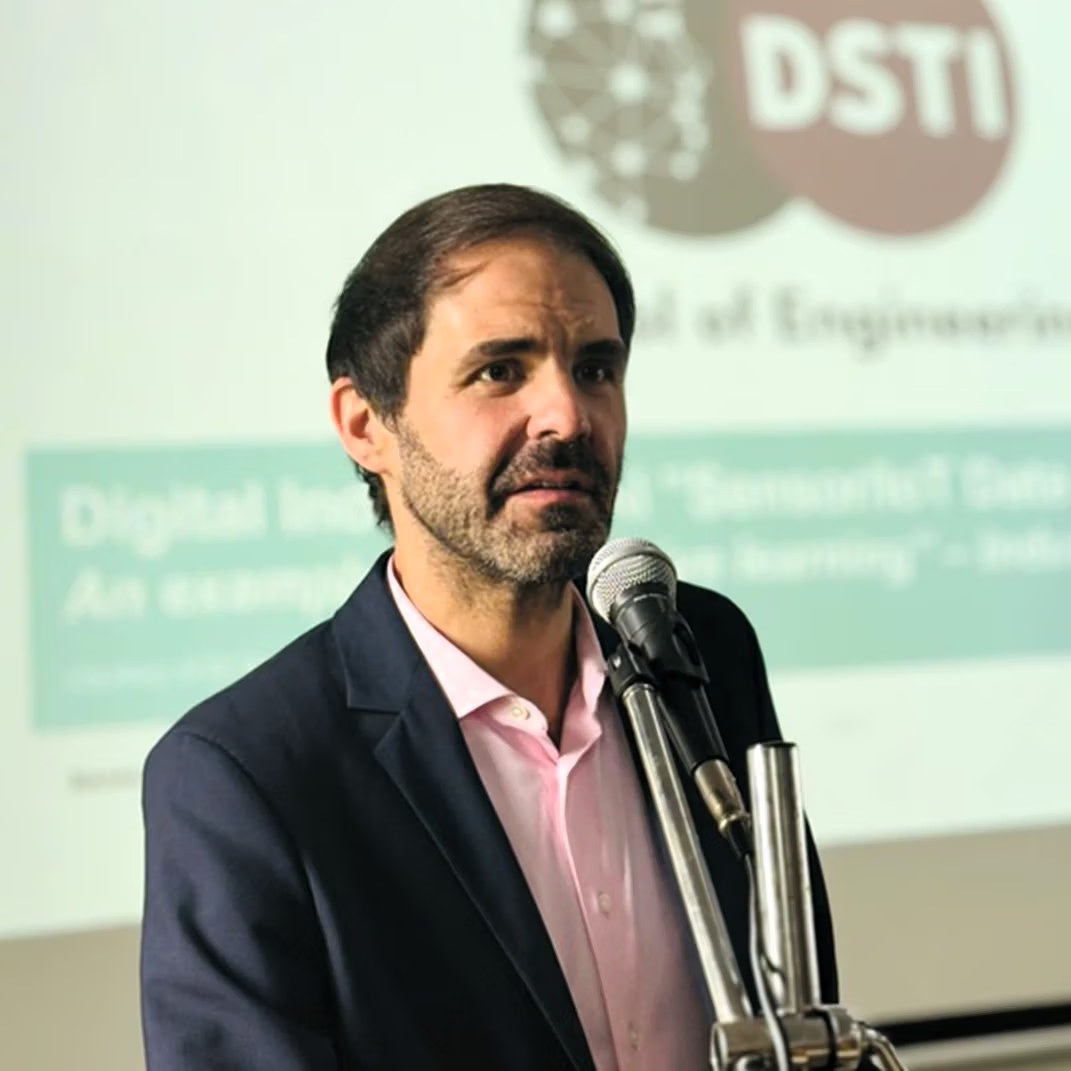
These are the main teams partners and applicants may need when working with DSTI. The people below are especially used to international contexts, partner relations and student support.
Whether the question is about partnerships, applications, academic progression or professional integration, DSTI gives partners and applicants direct access to the right team.
For partners, international partnerships and market coordination.


For applications, applicant follow-up, admissions documents and enrolment guidance.


For academic matters, programme follow-up, study progression and Direction of Studies coordination.


For internships, employer relations, professional integration and corporate partnerships.


Every conversation with a prospective student or family matters. By helping applicants understand France, DSTI, our programmes and our expectations, you help them make a serious, informed and life-changing decision.
We are grateful for the trust, professionalism and local insight our partners bring to this work. Together, we can guide the right students towards the right pathway — and help them build their future in AI, Data, Computing and Cybersecurity.
Follow DSTI online.
Use this section to invite students, parents and partners to follow DSTI across platforms for school updates, events, student life, learning content and destination inspiration.
Stay connected with DSTI.
Follow our channels to see the school in motion: academic life, student stories, campus atmosphere, events, webinars, AI and data content, and the French experience behind the programmes.
LinkedIn
The best channel for institutional news, professional updates, events, partnerships, employability content and serious academic positioning.
YouTube
Useful for longer videos, webinars, school presentations, programme explainers and content students can watch before applying.
Facebook
A useful channel for broader community visibility, announcements, event sharing and family-friendly updates.
Instagram
Good for visual storytelling: campuses, student life, French Riviera and Paris atmosphere, events, visits and everyday DSTI moments.
TikTok
Short, accessible videos for younger audiences: quick insights, destination content, student-facing messages and informal discovery.